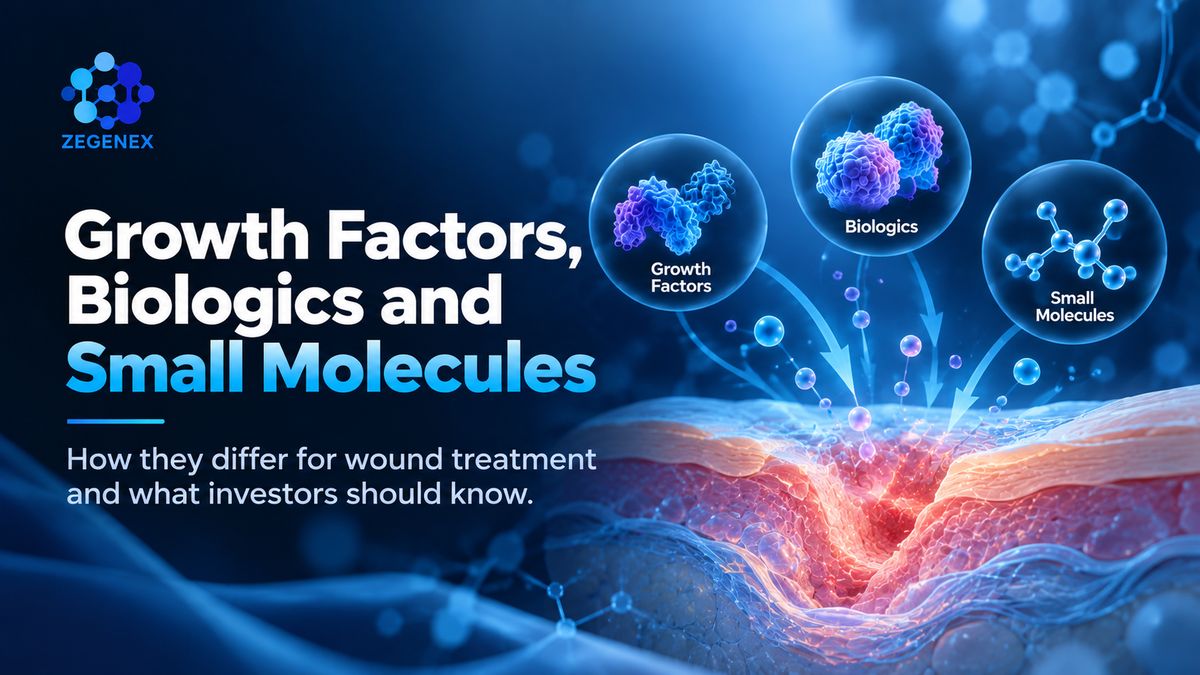
Chronic wound treatment today draws on three therapy classes. Growth factors deliver signaling proteins to the wound. Biologic products supply living or processed tissue and matrix. Small molecules are chemically synthesized compounds that act on cell pathways. They differ mainly in mechanism, stability, handling and manufacturing complexity, and those differences shape clinical and commercial outcomes.
Which Solution Is Best for Wound Healing?
No class is best across all wounds. Choice depends on wound type, blood supply, infection status and cost. Growth factors and biologics have the longest clinical record but demand careful handling. Small molecules are earlier in development for wounds and offer practical advantages that still need human data to confirm. You can read more about this approach on our Our Science page.
Wound healing solutions sit on top of standard care: offloading or compression, debridement, infection control and dressings. Advanced products are generally added when that foundation is not enough. For a closer look at how this plays out in one of the most common chronic wounds, see our article on diabetic foot ulcer treatment in the US. The table below compares the three classes in general terms; individual products vary.
| Growth factors | Biologic products | Small molecules | |
|---|---|---|---|
| How they work | Deliver signaling proteins that stimulate cell migration, proliferation and new vessel growth | Provide cells, matrix or tissue-derived material that acts as a scaffold or source of signals | Act on specific cell pathways involved in repair, such as angiogenesis or proliferation |
| Storage and handling | Protein products generally need cold storage; an FDA-approved recombinant gel is labeled for refrigeration | Often need controlled storage and careful preparation, depending on the product | Chemically stable compounds can often be formulated for simpler storage, depending on the formulation |
| Manufacturing complexity | Recombinant protein production in biological systems; complex and costly | Tissue sourcing, processing and consistency add complexity | Chemical synthesis is generally more scalable and consistent |
| Limitations | Proteins can be sensitive to the wound environment; delivery is challenging; safety labeling can limit use | Variable evidence, cost and logistics; payment rules have tightened | Limited wound-specific clinical data so far; mechanism and safety must be shown in each indication |
For an example of the growth-factor class, becaplermin is an FDA-approved recombinant growth-factor gel indicated, according to its label, as an adjunct to good ulcer care for certain diabetic lower-extremity ulcers with adequate blood supply. Its label specifies refrigerated storage at 2 to 8 degrees Celsius and carries a malignancy-related warning. It illustrates both the promise and the practical constraints of the class. Our competitive matrix shows how these constraints compare across approaches.
What Promotes Wound Healing?
Healing is promoted by an orderly sequence of hemostasis, inflammation, proliferation and maturation, supported by adequate oxygen and blood supply, infection control and pressure relief. Therapies aim to restore that sequence where it has stalled, most often by supporting new vessel growth and cell proliferation in the wound bed.
The wound healing mechanism in brief
A review of angiogenesis in wound healing describes four overlapping stages. After bleeding is controlled, neutrophils and then macrophages arrive and influence both scarring and new vessel growth. The wound then fills with granulation tissue rich in new vessels, and finally vessels are stabilized and excess ones pruned. A short animation of these phases is available in our 5-phase wound healing video.
Several signaling pathways drive these stages:
- Hypoxia signaling: Low oxygen activates HIF-1α, which switches on angiogenic genes including VEGF-A.
- Growth factor signaling: FGF-2 and VEGF-A depend on supporting molecules at the cell surface, and the review notes these are reduced in diabetic skin.
- Vessel stabilization: PDGF-BB and angiopoietin signaling help recruit support cells that stabilize new vessels.
- Proliferation pathways: PI3K/Akt and ERK1/2 relay signals from growth factors such as EGF.
In chronic wounds these signals can be disrupted. The same review reports that a wide range of strategies, including proteins, gene delivery and other agents, are being explored to restore them. A separate review of growth factors and growth factor gene therapies covers the protein-based side of this work in more detail. The effectiveness of any one approach in people must be shown in clinical trials.
What Is the Best Topical Treatment for Wound Healing?
There is no single best topical. Moisture-balancing dressings are standard, and prescription topicals include recombinant growth-factor gels. Newer approaches include topical small molecules. The best choice depends on the wound, the evidence and practical factors such as storage, application and cost.
Small molecule wound healing: what the literature says
Reviews describe small molecules, including many from natural sources, that appear to modulate inflammation, support cell proliferation or have antimicrobial effects in wound models. The authors of one 2023 review stress that laboratory findings do not substitute for well-conducted clinical trials. That caution applies to the whole class.
Small molecules also differ from proteins in kind. They are chemically defined, which generally allows consistent manufacturing and, depending on the formulation, simpler storage. A 2023 review of hydrogels delivering small molecules for diabetic wounds discusses their antioxidant, anti-inflammatory and antimicrobial properties, while noting that delivery platforms matter.
Developers are interested in non-protein options partly because protein therapies, such as becaplermin, are costly to make and handle. That interest is a hypothesis about practicality, not evidence of benefit, and every candidate must prove itself in trials.
How Does FDA Oversight and Payer Pressure Shape the Category?
FDA reviews topical wound therapies as drugs, biologics or devices depending on the product, and its guidance for chronic ulcers covers all three. Payers add cost pressure: one analysis estimated total Medicare spending on all wound types at $28.1 to $96.8 billion in 2014, and CMS has moved most skin substitutes to a flat payment rate.
The US regulatory role
FDA's guidance on chronic cutaneous ulcer products was issued by its drug, biologics and device centers. It notes that no animal model of chronic wounds is ideal, so sponsors typically use more than one model. In practice, preclinical validation is a gating step before first-in-human studies. You can see how this fits into a development timeline on our clinical pipeline page.
Payer cost pressure
Medicare spending on wound care is large and mostly outpatient, as described in this economic evaluation of chronic nonhealing wounds. Starting in 2026, CMS finalized a flat payment of roughly $127 per square centimeter for most skin substitutes, per the CY 2026 Physician Fee Schedule final rule fact sheet. For developers, the lesson is general: products that depend on premium pricing face more scrutiny than products with lower cost of goods. More on the broader economics is on our market opportunity page.
Why Does Therapy Class Matter Commercially, and What Should Investors Watch?
Therapy class shapes cost of goods, cold-chain needs, batch consistency and the ease of scaling. Classes with simpler manufacturing and storage can lower distribution friction for clinics and distributors. Investors should watch preclinical validation first, then early clinical readouts, because class advantages only matter if efficacy and safety hold up in people.
- Stability and storage: Does the formulation tolerate normal distribution conditions, or does it need a cold chain?
- Manufacturing: Is the process reproducible and scalable, and how sensitive is cost of goods to volume?
- Handling: How many steps does a clinician or caregiver need to apply it?
- Preclinical validation: Is activity reproducible across more than one relevant wound model?
- Early clinical readouts: Do Phase I safety data and Phase II closure signals, measured against standard care, support the class thesis?
None of these attributes is a substitute for evidence. A convenient product that does not improve outcomes has no commercial case, which is why class-level advantages should be treated as hypotheses until human data arrive. Investors and partners who want to learn more can visit our partnerships and investor relations page.
Frequently Asked Questions
What is the difference between growth factors, biologics and small molecules for wounds?
Growth factors are signaling proteins, biologic products supply tissue or matrix, and small molecules are chemically synthesized compounds that act on cell pathways. They differ in storage, manufacturing complexity and evidence.
Why have growth factor therapies had limited uptake?
Proteins are sensitive to storage and to the wound environment, and one approved gel carries refrigeration requirements and a malignancy-related warning on its label. Cost and delivery are also cited as challenges.
What does the FDA regulate in wound therapies?
FDA regulates wound products as drugs, biologics or devices, depending on how they work. Its guidance for chronic ulcers addresses preclinical models, standard care and clinical endpoints.
Is the evidence for small molecules in chronic wounds established?
Not as a class. Laboratory results are encouraging in some models, but reviewers stress that clinical trials are needed to establish benefit in people.
What should investors watch in this category?
Reproducible preclinical validation, then early clinical safety and closure signals, alongside practical factors such as stability and manufacturing scalability.
About ZegeneX
ZegeneX is developing Zegen-X5, an investigational, preclinical, shelf-stable small-molecule topical therapy being evaluated for diabetic foot ulcers and other hard-to-heal wounds. Learn more about the science behind Zegen-X5, the company, or get in touch.
This article is for informational purposes only and is not medical advice. Zegen-X5 is an investigational compound and has not been approved by the US FDA.
Sources
- FDA label for Regranex (becaplermin) gel
- FDA, Chronic Cutaneous Ulcer and Burn Wounds: Developing Products for Treatment
- Veith et al., Therapeutic strategies for enhancing angiogenesis in wound healing, Adv Drug Deliv Rev
- Growth factors and growth factor gene therapies for treating chronic wounds
- Evidence for natural products as alternative wound-healing therapies, Biomolecules 2023
- Natural polymeric hydrogels encapsulating small molecules for diabetic wound healing, Gels 2023
- Nussbaum et al., Economic evaluation of chronic nonhealing wounds, Value in Health 2018
- CMS, CY 2026 Physician Fee Schedule final rule fact sheet
Translational Innovation from the University of Pittsburgh
ZegeneX Therapeutics is advancing first-in-class small-molecule regenerative wound healing therapeutics licensed from the University of Pittsburgh to eliminate avoidable diabetic amputations worldwide.